You are about to make a swap, but the asset is on the wrong network. Your funds sit on one EVM chain, the opportunity is on another, and the familiar browser-wallet routine suddenly involves network selection, token approvals, bridge risk, gas fees, and a transaction preview that is easy to misread. For a US-based DeFi user, this is no longer an unusual edge case. Liquidity is distributed across many Ethereum-compatible networks, while the wallet remains the place where a human must approve what software proposes.
That is the practical setting for evaluating a Rabby wallet extension. The important question is not simply whether a wallet can display balances or connect to a decentralized application. It is whether the wallet helps you understand a transaction before signing it, especially when a cross-chain swap combines several moving parts. Rabby’s current positioning as a wallet for Ethereum and EVM chains reflects that broader shift: the wallet is becoming less a digital key holder and more an interface for interpreting complex on-chain actions.
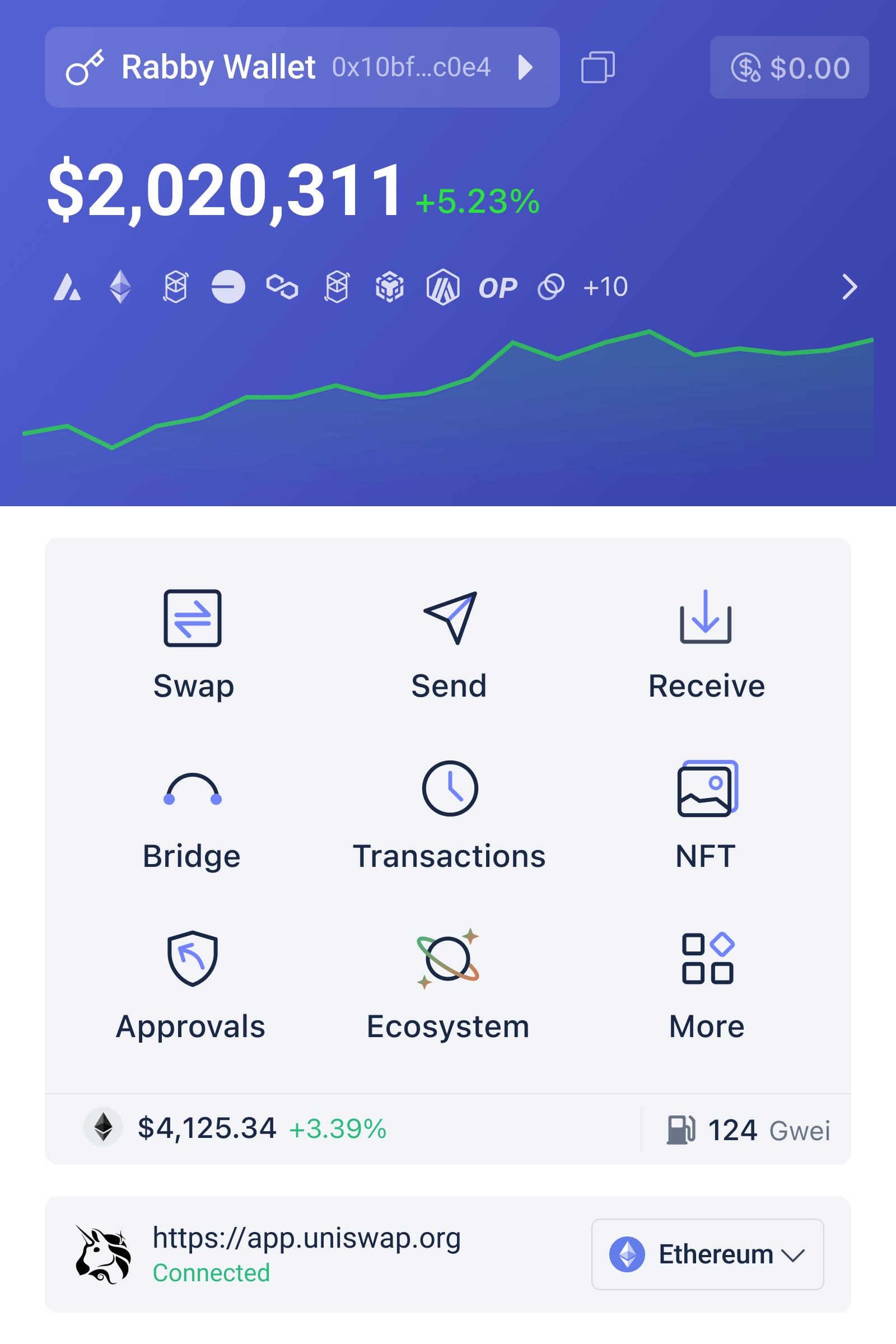
From single-network wallets to multi-chain control panels
Early Ethereum wallets were designed around a relatively simple mental model: choose a network, hold a token, connect to an application, and sign a transaction. That model became harder to maintain as layer-2 networks and other EVM-compatible chains expanded. The underlying account format may look familiar across networks, but balances, gas assets, contract deployments, liquidity, and application behavior can differ substantially.
This distinction matters because “the same address” does not mean “the same funds.” An address can exist on multiple EVM chains, yet the token balance on one network is not automatically available on another. Moving value may require a bridge, a cross-chain messaging system, or a swap route that includes both a transfer and an exchange. A wallet that merely switches network labels can leave the user with an incomplete picture.
The newer wallet challenge is therefore interpretive. Before signing, a user needs to know which chain is involved, which contracts will receive permission, what token will be spent, what token is expected in return, and whether the route depends on an external bridge or intermediary. This is where transaction simulation and readable warnings can be more valuable than a long list of supported networks. Network breadth is useful only if it does not increase confusion faster than it increases access.
What a Rabby extension download should help you evaluate
Installing a browser extension is not the same as making a DeFi position safe. The extension supplies an interface and, depending on the setup, a way to authorize transactions with a wallet account. The security outcome still depends on the software source, the websites visited, the permissions granted, the device environment, and the user’s signing decisions.
For that reason, use an official-looking installation path carefully and verify the extension’s identity before importing or creating an account. Readers who need a starting point for the installation process can review this rabby extension download resource, then confirm that the extension is installed in the intended browser and that its permissions make sense. Never enter a recovery phrase into a web form, support chat, or unsolicited pop-up. A browser wallet should not require a secret phrase to “verify” a transaction.
A useful installation test is not merely whether the wallet opens. Connect it to a familiar application with a small amount of funds and inspect the transaction preview. Look for the network, the target contract, the assets being transferred, and any approval that appears broader than necessary. If the preview is difficult to interpret, pause. The friction is information: complex transactions deserve more scrutiny than ordinary transfers.
Cross-chain swaps: two alternatives that are easy to confuse
Cross-chain swaps are often described as though they were one operation. In practice, users usually encounter at least two broad approaches. The first is a bridge-first workflow: move an asset from the source chain to the destination chain, wait for the transfer process to complete, and then trade on a decentralized exchange. The second is an integrated route offered through a cross-chain service, where the user specifies the source asset and destination asset and the service coordinates the underlying movement and exchange.
Bridge first, trade second
The bridge-first model offers transparency. You can inspect the transfer separately from the later swap, compare bridge conditions, and decide when to proceed. It can also be useful when you expect to remain on the destination chain and want to hold a commonly used gas token there.
The cost is operational complexity. You may need to approve the source token, initiate the bridge, wait for finality or message delivery, add or select the destination network, and then execute a second transaction. Fees can arise at multiple stages. A bridge may also expose you to smart-contract, validator, relayer, or liquidity risks that do not exist in the same form for a simple on-chain trade.
Integrated cross-chain routing
An integrated route can reduce clicks and may choose among liquidity sources automatically. That convenience is meaningful when the user wants a specific destination asset rather than a separate bridged representation of the original token. It also reduces the chance of forgetting the destination chain or arriving without enough gas for the next action.
But convenience can conceal dependencies. The quoted output may rely on several contracts, a bridge mechanism, and time-sensitive liquidity. A route with fewer visible steps is not necessarily a route with fewer technical steps. It may simply bundle them into one user experience. If the wallet shows a simulation or warning, read it as a risk map rather than a decorative confirmation screen.
The real comparison: convenience, control, and failure modes
The best workflow depends on the user’s objective. If the goal is a one-time conversion into an asset on another chain, an integrated route may be practical, provided the expected output, fees, slippage, and route components are understandable. If the goal is treasury management, recurring liquidity provision, or a large transfer, a bridge-first process may be preferable because it separates decisions and creates clearer checkpoints.
There is also a difference between price risk and execution risk. Slippage is the change in the expected exchange rate caused by market movement or limited liquidity. Execution risk is broader: a transaction may interact with an unexpected contract, require an excessive approval, fail after fees are spent, or complete in a way that leaves the user holding an asset that is difficult to use. A wallet can help surface some of these issues, but it cannot eliminate them.
Another boundary condition is chain quality. EVM compatibility standardizes important developer interfaces, not the economic security of every network. Each chain may differ in validator design, bridge support, liquidity depth, uptime, transaction ordering, and the quality of applications deployed there. A polished wallet interface can make networks feel equally familiar even when their risk profiles are not equivalent. The interface should improve judgment, not replace it.
Approvals deserve special attention. When a decentralized application asks permission to spend a token, the approval can sometimes cover a specific amount or a much larger allowance. A broad allowance is convenient for future transactions but increases the consequences if the approved contract is compromised or misused. For active DeFi users, periodically reviewing and reducing unnecessary allowances is a sensible part of wallet hygiene. It is a separate task from disconnecting a website, because disconnecting usually does not revoke on-chain permissions.
A reusable checklist for safer multi-chain swaps
Before signing, identify the source chain and destination chain independently of the asset names. Then confirm the exact token contract where ambiguity is possible; similarly named tokens and wrapped assets are not interchangeable merely because their tickers resemble one another. Next, compare the quoted output with the amount you expect after network fees, service fees, bridge costs, and slippage. A favorable headline exchange rate can be less attractive once the full route is priced.
After that, inspect the approval and the contract interaction. Ask whether the spender is the application or a routing contract, whether the allowance is larger than needed, and whether the transaction preview matches your intention. For a first transaction, use a small test amount when the route or application is unfamiliar. This does not protect against every failure, but it can reveal wrong-network mistakes, unsupported assets, or unexpected destination behavior before the full balance is exposed.
Finally, plan for the destination state. Will you have enough native gas currency to move or trade the received asset? Is the token supported by the application you intend to use? Can you distinguish a canonical asset from a bridged version? Cross-chain operations are not finished merely when a balance appears. They are finished when the received asset is usable for the purpose that justified the transfer.
What to watch as EVM wallet design evolves
The recent emphasis on a wallet serving Ethereum and EVM chains points toward a broader design problem: users increasingly need chain abstraction without losing transaction-level understanding. Future wallet improvements may make routing, gas management, and network selection feel more unified. The critical test will be whether that abstraction preserves meaningful disclosure about bridges, contracts, permissions, and settlement conditions.
If wallets hide too much, users may approve actions they cannot reconstruct. If they expose every technical detail without prioritizing risk, users may click through warnings as routine noise. The most useful direction lies between those extremes: concise explanations for ordinary actions, deeper inspection when the route is unusual, and clear escalation when a transaction involves broad permissions or unfamiliar contracts.
FAQ
Is a Rabby browser extension enough to make cross-chain swaps safe?
No. A wallet can improve transaction visibility and help identify some network, contract, or approval issues, but it cannot guarantee the safety of a bridge, decentralized application, token, or destination chain. Users still need to verify the installation source, review transaction details, and manage approvals carefully.
Should I bridge an asset first or use an integrated cross-chain swap?
Use the bridge-first approach when you want clearer separation between moving funds and trading, or when you plan to keep the asset on the destination chain. An integrated route may be more convenient for a one-time conversion, but inspect the complete route because fewer visible steps can still involve several underlying contracts and services.
Why can I see the same wallet address on several EVM chains but not the same balance?
The address format can be valid across multiple EVM networks, while balances are recorded separately on each chain. Funds must be transferred through a supported bridge or cross-chain mechanism before they become available on another network. Address similarity is not evidence that assets are already portable.
What is the most useful habit for a new DeFi wallet user?
Read the transaction as a set of permissions and state changes, not merely as a button labeled “Confirm.” Check the chain, token, spender, amount, destination, and expected result. That mental model remains useful whether you are making a simple swap or navigating a multi-step cross-chain route.
Rabby’s value in a multi-chain workflow is best understood as decision support at the moment when abstract protocol activity becomes a real authorization. The extension can make the path easier to inspect, but the final advantage comes from matching the tool to the task: convenience for small, understandable routes; deliberate checkpoints for large or unfamiliar ones; and skepticism whenever a clean interface makes a complicated transaction look simple.
Sin respuestas